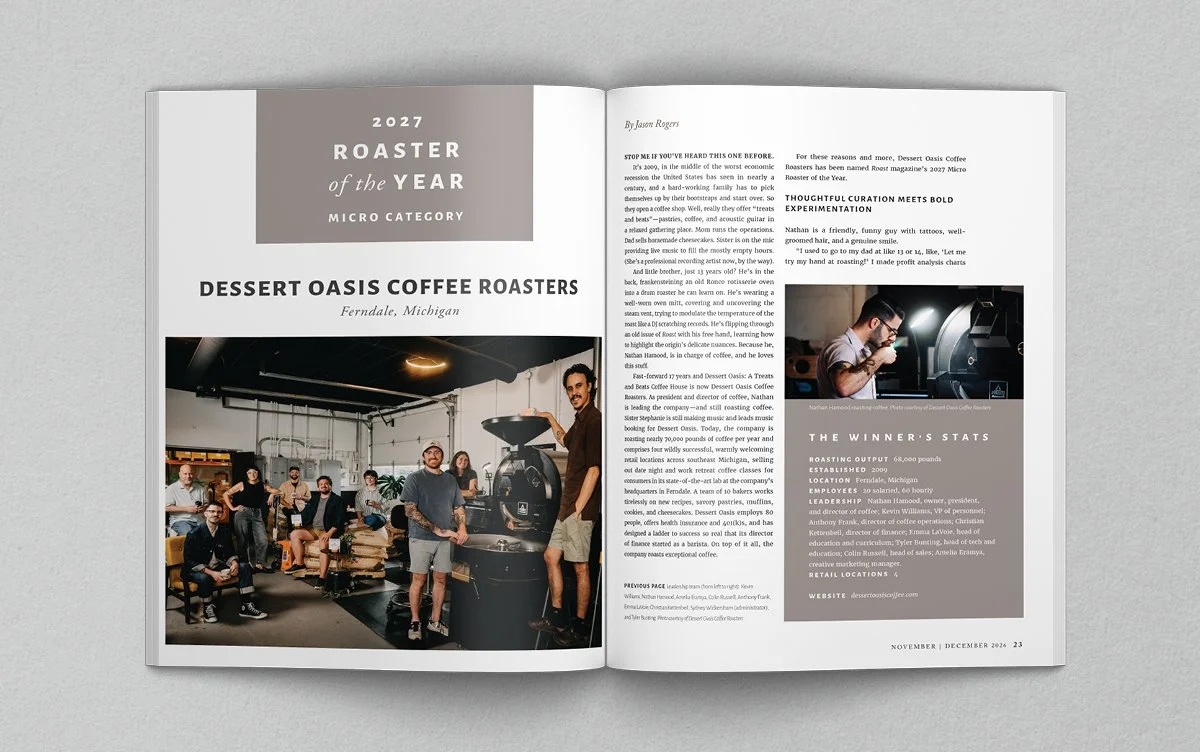
Leadership team (from left to right): Kevin Williams, Nathan Hamood, Amelia Eramya, Colin Russell, Anthony Frank, Emma LaVoie, Christian Kettenbeil, Sydney Wickersham (administrator), and Tyler Bunting.
By Jason Rogers
Stop me if you’ve heard this one before.
It’s 2009, in the middle of the worst economic recession the United States has seen in nearly a century, and a hard-working family has to pick themselves up by their bootstraps and start over. So they open a coffee shop. Well, really they offer “treats and beats”—pastries, coffee, and acoustic guitar in a relaxed gathering place. Mom runs the operations. Dad sells homemade cheesecakes. Sister is on the mic providing live music to fill the mostly empty hours. (She’s a professional recording artist now, by the way).
And little brother, just 13 years old? He’s in the back, frankensteining an old Ronco rotisserie oven into a drum roaster he can learn on. He’s wearing a well-worn oven mitt, covering and uncovering the steam vent, trying to modulate the temperature of the roast like a DJ scratching records. He’s flipping through an old issue of Roast with his free hand, learning how to highlight the origin’s delicate nuances. Because he, Nathan Hamood, is in charge of coffee, and he loves this stuff.
Fast-forward 17 years and Dessert Oasis: A Treats and Beats Coffee House is now Dessert Oasis Coffee Roasters. As president and director of coffee, Nathan is leading the company—and still roasting coffee. Sister Stephanie is still making music and leads music booking for Dessert Oasis. Today, the company is roasting nearly 70,000 pounds of coffee per year and comprises four wildly successful, warmly welcoming retail locations across southeast Michigan, selling out date night and work retreat coffee classes for consumers in its state-of-the-art lab at the company’s headquarters in Ferndale. A team of 10 bakers works tirelessly on new recipes, savory pastries, muffins, cookies, and cheesecakes. Dessert Oasis employs 80 people, offers health insurance and 401(k)s, and has designed a ladder to success so real that its director of finance started as a barista. On top of it all, the company roasts exceptional coffee.
For these reasons and more, Dessert Oasis Coffee Roasters has been named Roast magazine’s 2027 Micro Roaster of the Year.

Nathan Hamood roasting coffee.
THOUGHTFUL CURATION MEETS BOLD EXPERIMENTATION
Nathan is a friendly, funny guy with tattoos, well-groomed hair, and a genuine smile.
“I used to go to my dad at like 13 or 14, like, ‘Let me try my hand at roasting!’ I made profit analysis charts to show him how if we roasted our own coffee, we wouldn’t have to actually spend that much more,” he remembers with a laugh. “I wish I could go back and taste that coffee because I’m sure it was garbage.”
But love finds a way. And so, from the humblest of beginnings, Nathan honed his craft, graduating to bigger and better roasters as customers started catching on to the special things happening in the back of Dessert Oasis. “I used to have to explain what a pourover was at the beginning,” he recalls.
Today, Dessert Oasis roasts on a Probat P12 Series III, a Rolls Royce of the roasting world. Or maybe it’s more like a ‘90s Toyota Supra—high performance, limitlessly customizable, and designed not to obfuscate or cover up the skills of the roaster, but to give them the control to drive the roast in any way they want.
“Our Probat allows for a very tight dialing of gas pressure and airflow, with an air mix burner and variable fan drive, with a bit more of a convective input than perhaps the most traditional drum roasters,” Nathan explains. “That’s been such a key thing in our roast philosophy: really letting the coffee shine.” That means everything from articulating clean, dynamic coffees with clarity, crisp acidity, and brightness to rounding the cup with sweetness and dimension to highlighting the characteristics of the coffee’s origin and variety.
This roasting philosophy was especially evident in Dessert Oasis’s Summer Hills Blend, which impressed Roaster of the Year sensory judges with its strawberry and fruit punch juiciness and well-rounded acidity, perfectly balanced with unctuous nuttiness. “We don’t really do a lot of blends,” says Nathan. “We’re really focused on single-origin coffee, so if we’re going to do a blend, it’s going to be what we love about single-origin coffee but represented in a blend.”
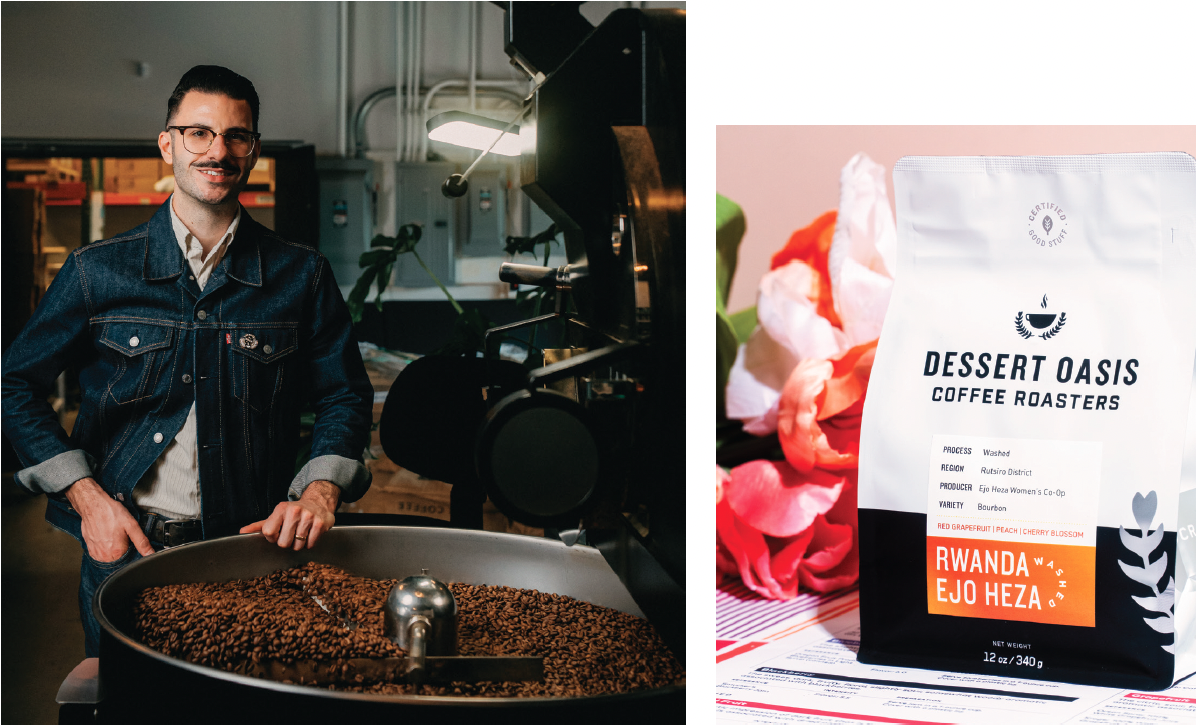
(Left) Nathan Hamood, president and director of coffee, inside the Dessert Oasis roastery.
(Right) Dessert Oasis has worked with Rwanda’s Ejo Heza women’s cooperative and served its coffee in cafes for 13 years.
To create this delightful concoction, Dessert Oasis began with a base of Colombia Luis Anibal Calderon Washed Pink Bourbon, incorporating a small amount of Hacienda La Papaya Natural to “get some of that natural-process roundness, but also some nicely articulated clean florals,” says Nathan, then adding some Jairo Arcila Strawberry Wine Yeast for some “fun wildness.” The goal, as Nathan puts it, was to “create something really interesting that showcases some fun flavors and character.”
This experimenting is indeed fun, but it doesn’t happen in a vacuum. Dessert Oasis connects with its consumers by inviting the general coffee-drinking public to participate in the profiling process, selling test batches of coffees the company is still actively profiling at its Ferndale cafe and asking patrons for feedback.
That feedback isn’t always helpful. “Sometimes people will say, ‘It’s way too sour.’ And we’re like, ‘I’m actually not sure it’s sour at all,’” Nathan says with a shrug and a good-humored shake of his head, but you do get a good feel for the market.” And because Dessert Oasis spends so much time, talent, and treasure on educating the local community, it has created a positive feedback loop, where better-educated coffee drinkers are beginning to provide better-educated critiques and suggestions.
It’s also a shrewd business tactic, freeing the staff to be more creative with their profiling by crowdfunding their bolder experiments. “It gives us permission to be ourselves, to be more experimental with our profiles, because I can recoup some of the profiling costs and don’t have to feel as bad about wasting coffee,” Nathan says.
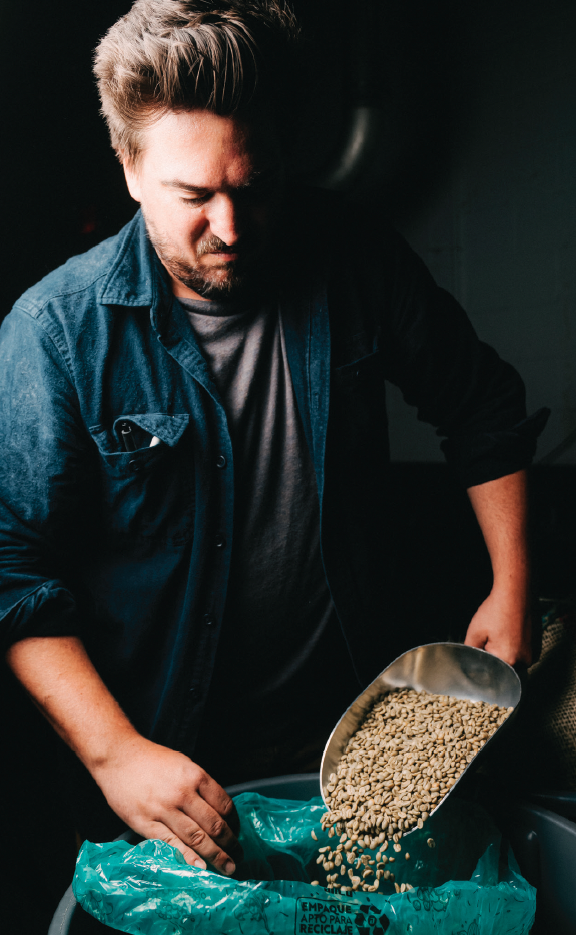
Anthony Frank, director of coffee operations, preparing to weigh green coffee for roasting.
With such a focus on nuance and contrast—and a willingness to invest time and capital into dialing in every roast profile—it’s impossible to separate Dessert Oasis’s excellence in roasting from its forward-thinking sourcing. The company moved away from spot buying years ago to create reliable, predictable partnerships with producers that can scale as the company does. Nathan and his team worked hard, connecting with producers and importers around the world and committing to forward contracts with producers they trusted, and in whose coffee they believed. “We have one coffee from a women’s cooperative in Rwanda,” Nathan notes. “It’s our 13th year working with them. … We seek out coffees that we’re just really excited to share, and try to represent that producer the best we can through our final product.”
Dessert Oasis is committed to presenting its coffees like biographies of the producers who grew them, and as tributes to the craftsmanship that created them. That commitment is especially clear in the company’s Yessica Parra Natural Sidra. A fourth-generation coffee grower from Colombia, Yessica and her family process this Sidra variety with an experimental natural process that involves harvesting and floating the cherries for a second selection, leaving them in open tanks for 24 hours before a thermal shock process in which hot water is added for 30 minutes. This is followed by another 80 hours of fermentation, during which the coffee juice from the past fermentation is added, before the coffee is dried on raised beds for up to three weeks.
“We love fun varietals like Sidra, and we love when a process allows that varietal to really shine through,” Nathan says. The result is a sweet, vibrant, dynamic cup that delighted sensory judges with notes of tropical fruit, a honey-like syrupy body, and clean, citric-like acidity.
CREATING PATHS TO PROSPERITY
Despite its excellence in roasting and sourcing, the thing that most makes Dessert Oasis stand out is its commitment to its employees, and to the education that makes career advancement possible. The company invests heavily in employee education, in terms of both time and capital. The education team is led by three salaried professionals with more than 25 years of combined industry experience tasked with teaching the staff a custom curriculum—which includes both theory and technical skills. Every member of the Dessert Oasis team has access to 1:1 training on demand and large group classes conducted at the Ferndale HQ laboratory.
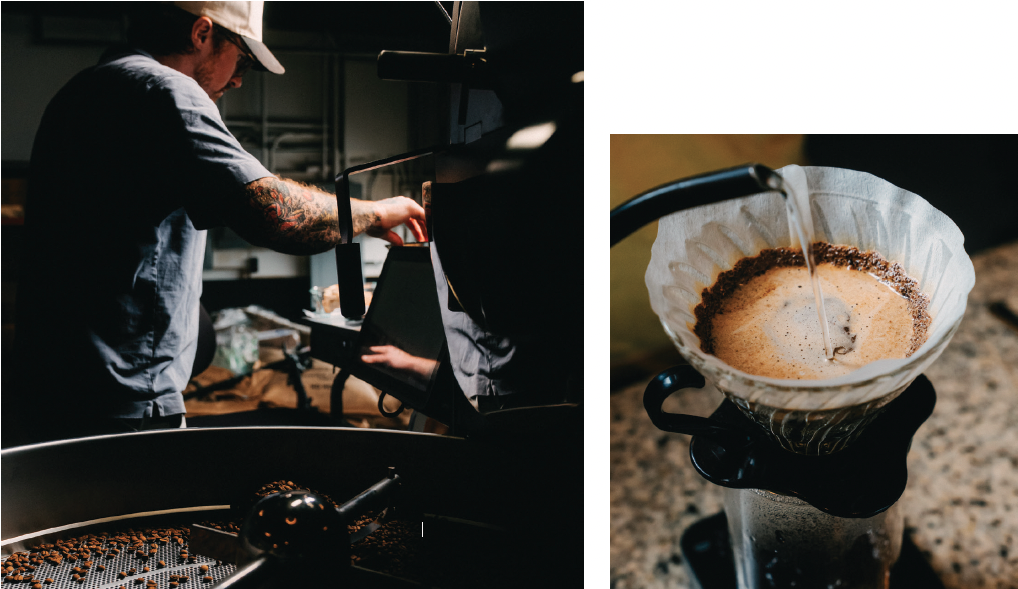
(Left) Christian Kettenbeil, director of finance, roasting coffee at the Dessert Oasis HQ in Ferndale.
(Right) A pourover being prepared by a barista at the company’s Ferndale cafe.
The goal of this robust education program is two-fold. The first is to ensure business continuity. As anyone working in the industry for long enough will tell you, employee turnover is real, and it’s a real pain in the back side. Knowledge is often siloed in the heads of a few select leaders, and if those leaders are sick or change jobs, that hard-won know-how often disappears with them. Dessert Oasis tackles this problem head-on, purposefully cross-training staff on a regular basis and in a structured environment so that even newly minted baristas have a firm grasp of roasting theory, marketing managers can speak with authority about origin characteristics and the pros and cons of different post-harvest processing techniques, and accountants can confidently pull the perfect espresso. As Nathan explains, “It creates so much more depth of infrastructure for what we’re doing here. It allows us to create better coffee and really elevate our craft.” Classes range from coffee harvesting and brewing basics all the way to advanced roasting theory and extraction science, and the interactive curriculum employs a wide array of modalities like short-form videos, extraction demos, and hands-on sensory analysis.
The second goal of Dessert Oasis’s investment in education is to genuinely make specialty coffee a viable long-term career path, even for employees who enter the industry as baristas or shipping and receiving associates. Upskilling is part of it, but incentivizing this career growth by handsomely compensating employees for it is, too. All training time is fully paid, obviously, but to directly incentivize growth, employees receive pay raises immediately upon completion of beginner, intermediate, and advanced training modules. Nathan and his team tie additional pay increases to completing additional certifications alongside more traditional merit-based raises.
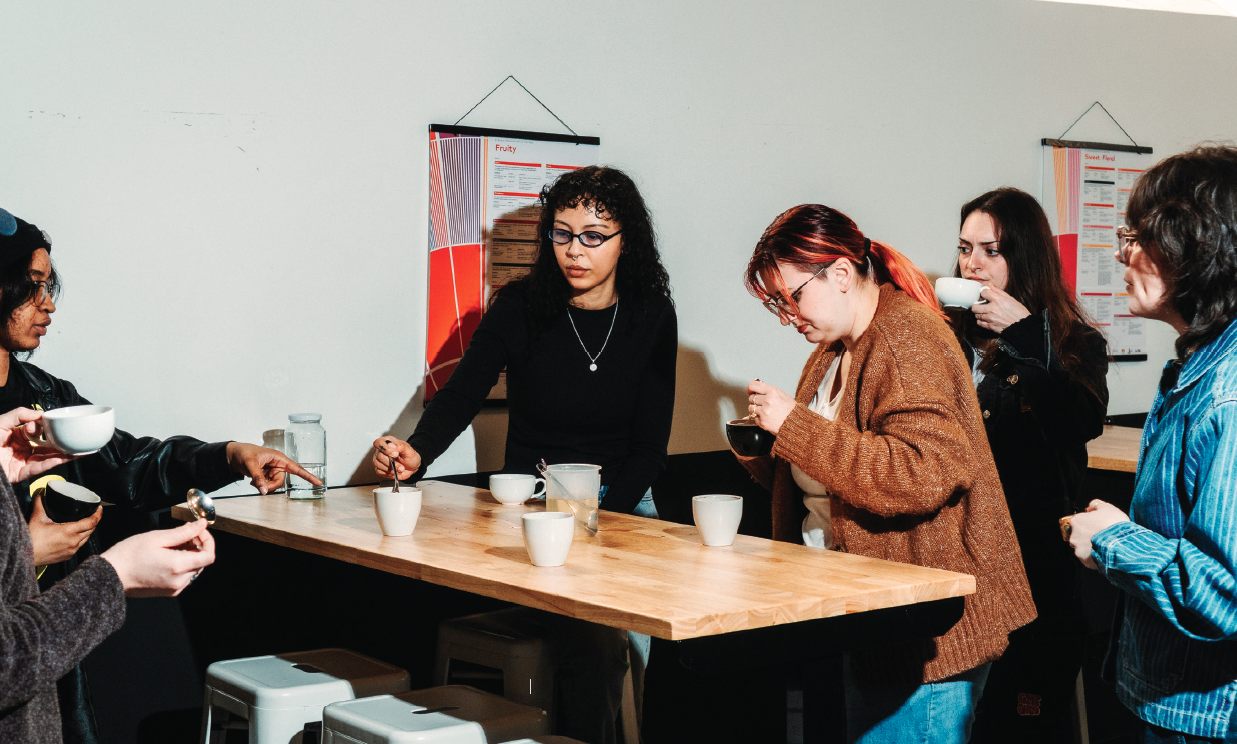
Head of Education and Curriculum Emma LaVoie leading a cupping for the company’s internal education program.
Once employees have completed all training modules, they have the opportunity to become Dessert Oasis certified educators. Certified educators are regularly tested on their specialty coffee knowledge, practical skills, palate and sensory understanding, and their ability to communicate their knowledge. Upon certification, educators may lead the classes Dessert Oasis offers to the public, and educators receive a commission for every class they teach.
“Testing for [Dessert Oasis Coffee Roasters] certification allows baristas the chance to research and develop their own class on any topic within the wide scope of specialty coffee. We find this excites them, and allows them to fuel their specific passions while enabling our education department to constantly evolve,” explains Emma LaVoie, head of education and curriculum. “We want them to pursue the career track that they’re most passionate about.”
“What we’re doing here allows us to create better career trajectories and pathways for new employees,” Nathan says. “I’d rather continue people’s training over a number of years and have the business benefit from that level of expertise than be training new people constantly and trying to piece things together.”
For Dessert Oasis, the proof is in the payroll. As mentioned, the company’s director of finance, Christian Kettenbeil, began with the company as a barista over a decade ago, training up to become a roaster before learning—and eventually leading—the financial side of the business.
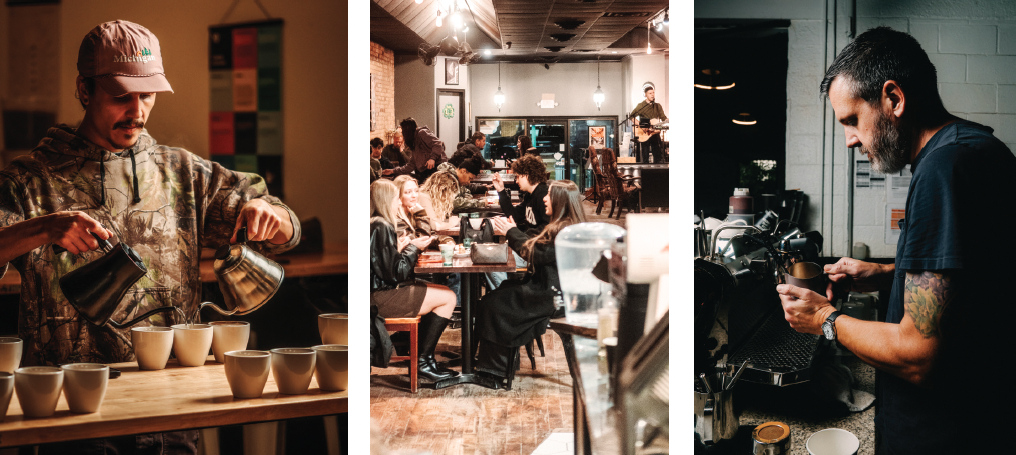
(Left) Head of Tech and Education Tyler Bunting preparing for a triangulation class as part of Dessert Oasis’s internal education program.
(Middle) Inside the company’s first cafe in Rochester during a weekly open mic night.
(Right) Barista Nick DePalma prepares a latte.
“My family here at [Dessert Oasis] has fostered my ambition from literally my first day on the job,” Christian says. “Every step of the journey they have pushed me to grow, and have never given me a reason to believe there’s a ceiling to that growth. I’m still keeping my skills sharp by roasting once a week, and that roasting shift is the part of my week that I covet.”
Kevin Williams, vice president of personnel, transitioned to Dessert Oasis after being laid off from his corporate job during the economic downturn in 2010. He started by doing dishes and assisting in the back of the house, but over time he “caught the coffee bug,” says Nathan, and began managing one of the shops. He later co-designed the comprehensive employee care and benefits program the company uses today. Anthony Frank joined the team 10 years ago, starting out as the manager of the Detroit store before transitioning into production and learning to roast under Nathan’s guidance. After working as production manager, he was promoted to director of coffee operations, taking on advanced responsibilities in green coffee supply chain management. Even the designers of the company’s education program—Emma LaVoie and Tyler Bunting—began their careers with Dessert Oasis as baristas.
As a result, professional advancement and long-tenured careers aren’t outliers at Dessert Oasis; they’re the norm. “It’s just a more meaningful way to do business, right?” Nathan says with the kind of shrug Spider-Man might give after saving a train full of commuters. “The margins are still the margins, so hopefully it makes some dollars and cents as well. But it’s a more meaningful way to do business.”
* * *
JASON ROGERS lives in Washington, D.C., with his wife and son and works as a writer and journalist. He loves hockey, rock climbing, and a travel mug of coffee on the golf course.
Advertisement