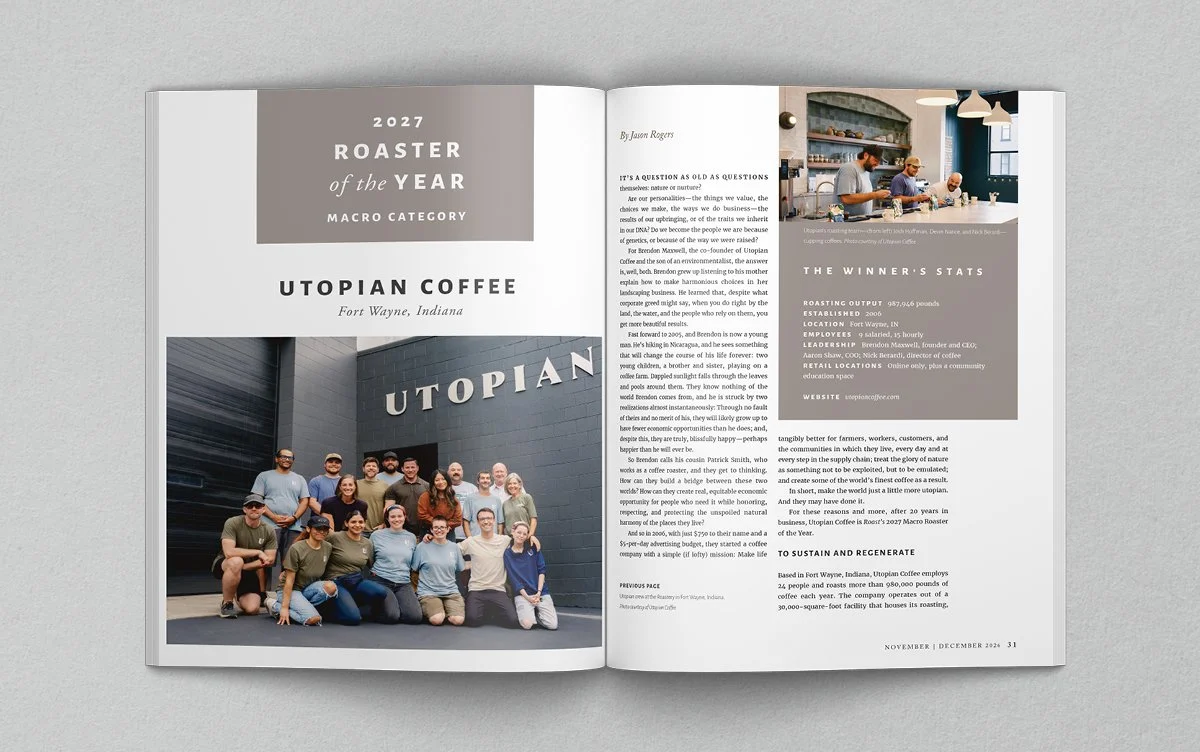
Utopian crew at the Roastery in Fort Wayne, Indiana.
By Jason Rogers
It’s a question as old as questions themselves: nature or nurture?
Are our personalities—the things we value, the choices we make, the ways we do business—the results of our upbringing, or of the traits we inherit in our DNA? Do we become the people we are because of genetics, or because of the way we were raised?
For Brendon Maxwell, the co-founder of Utopian Coffee and the son of an environmentalist, the answer is, well, both. Brendon grew up listening to his mother explain how to make harmonious choices in her landscaping business. He learned that, despite what corporate greed might say, when you do right by the land, the water, and the people who rely on them, you get more beautiful results.
Fast forward to 2005, and Brendon is now a young man. He’s hiking in Nicaragua, and he sees something that will change the course of his life forever: two young children, a brother and sister, playing on a coffee farm. Dappled sunlight falls through the leaves and pools around them. They know nothing of the world Brendon comes from, and he is struck by two realizations almost instantaneously: Through no fault of theirs and no merit of his, they will likely grow up to have fewer economic opportunities than he does; and, despite this, they are truly, blissfully happy—perhaps happier than he will ever be.
So Brendon calls his cousin Patrick Smith, who works as a coffee roaster, and they get to thinking. How can they build a bridge between these two worlds? How can they create real, equitable economic opportunity for people who need it while honoring, respecting, and protecting the unspoiled natural harmony of the places they live?
And so in 2006, with just $750 to their name and a $5-per-day advertising budget, they started a coffee company with a simple (if lofty) mission: Make life tangibly better for farmers, workers, customers, and the communities in which they live, every day and at every step in the supply chain; treat the glory of nature as something not to be exploited, but to be emulated; and create some of the world’s finest coffee as a result.
In short, make the world just a little more utopian. And they may have done it.
For these reasons and more, after 20 years in business, Utopian Coffee is Roast’s 2027 Macro Roaster of the Year.
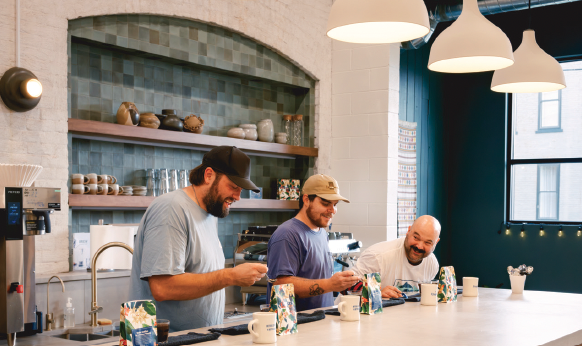
Utopian’s roasting team—(from left) Josh Hoffman, Devin Nance, and Nick Berardi—cupping coffees.
TO SUSTAIN AND REGENERATE
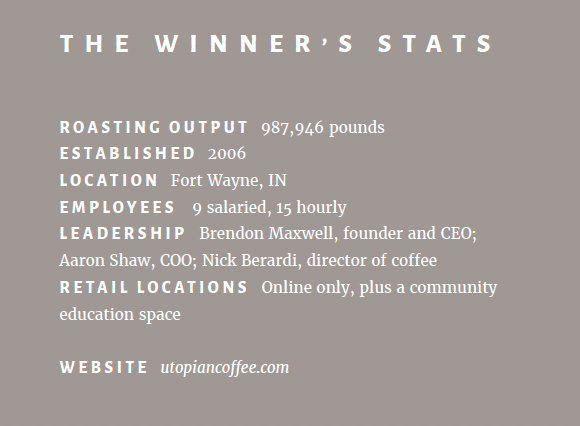
Based in Fort Wayne, Indiana, Utopian Coffee employs 24 people and roasts more than 980,000 pounds of coffee each year. The company operates out of a 30,000-square-foot facility that houses its roasting, packing, and fulfillment teams, as well as a state-of-the-art laboratory that serves as the heart of Utopian’s educational initiatives, hosting public tours, guided cuppings, community events, and tailored training sessions for its wholesale partners.
In the specialty coffee industry, the word “sustainability” gets tossed around like a sack of beans. It means good things that many businesses already are and should be doing. Like using water and pesticides judiciously at origin. Like paying fair prices and livable wages to producers. But with an operation as large as Utopian’s—roasting nearly a million pounds of coffee per year out of a 120-year-old historic building—there were many opportunities to walk the sustainability walk and practice what the company preaches both locally and globally.
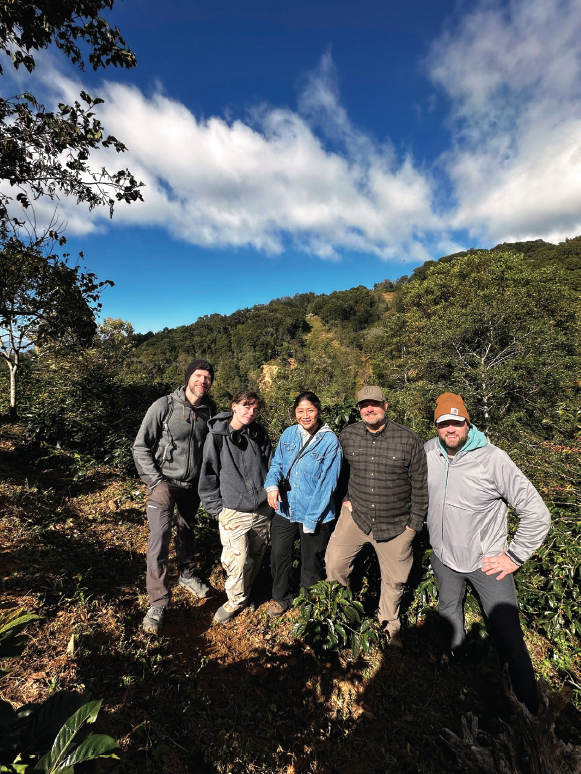
The Utopian crew visiting a coffee farm in Joyabaj, Guatemala.
When Brendon and team decided to renovate the company’s building, they saw a chance to lead by example. They rigorously adhered to LEED and Healthy Neighborhoods principles, installing energy-efficient HVAC and plumbing systems, preserving original building elements wherever possible, choosing to source used materials, and redesigning the landscape using permaculture practices—something Brendon’s mom, who works for the company as sustainability manager, is especially proud of. When it came time to power-wash the exterior brick walls, they paid extra to hire a company to capture the wastewater and dispose of it environmentally consciously, even going so far as to voluntarily register the process with the U.S. Environmental Protection Agency to ensure full compliance. They replaced the old roof with a better-insulated, high-efficiency one. They even went through the building’s lighting switch by switch, bulb by bulb, installing LEDs and automatic shut-off sensors.
With its house in order, Utopian turned to operations, cutting out waste like a surgeon with a scalpel—or a gardener with pruning shears. All unused coffee and food get composted to feed back into the earth. Chaff and leftover burlap from coffee sacks get donated to local farmers and landscapers as eco-friendly ground cover materials. In fact, these alternatives work so well that the company is currently piloting a program with the Fort Wayne municipal government to turn burlap into compost citywide. That raised the question: What else could burlap do? So the company partnered with the Empowered Legal Aid Network, an advocacy group for the local immigrant community, donating any excess burlap to be made into totes and backpacks which Utopian buys back to give to clients as gifts, creating a local circular economy.
And that’s all in addition to the company’s recycling program, which is so comprehensive and robust that at a recent team meeting, one employee joked that they take their trash home because it’s easier than throwing it away at the roastery.
Paraphrasing Aristotle, historian Will Durant famously said, “We are what we repeatedly do. Excellence, then, is not an act, but a habit.” And so is sustainability. Brendon describes these initiatives shockingly matter-of-factly, not fishing for praises or atta-boys but as simple choices a business can make.
For Utopian, what’s good for the earth can be good for the business, too. “We’ve just been really scrappy since the beginning,” Brendon says. “That idea of resourcefulness is just baked into the culture. The commission, the challenge that we have for new initiatives is, all right, how do we make this financially sustainable? You may be paying a little more upfront, but you’re getting it back over time.”
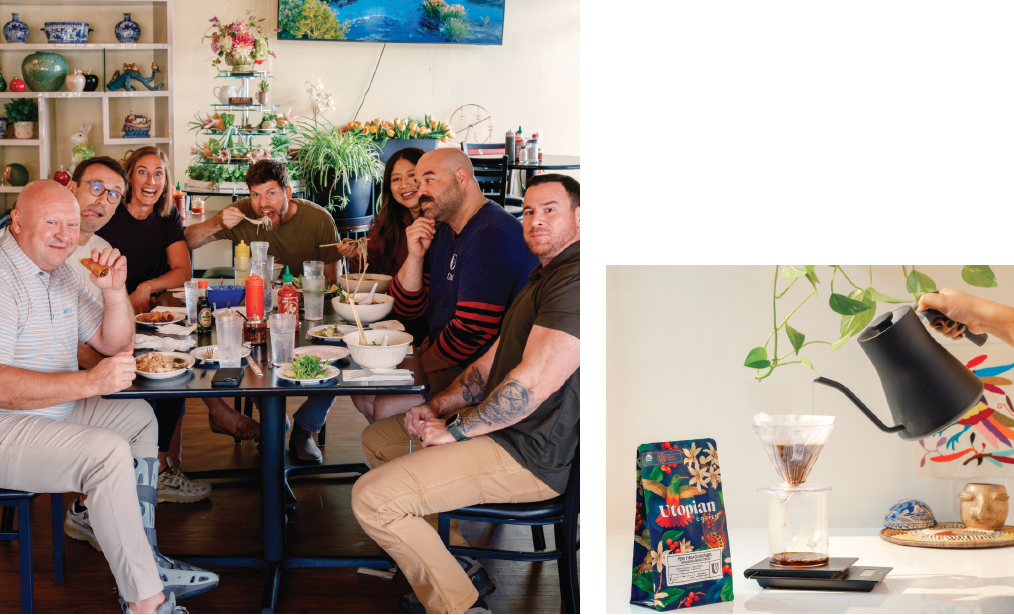
(Left) Leadership team lunch. (Left to right) Tim Pieper, Scott McKaig, Carly Maxwell, Brendon Maxwell, Chloe Carey, Nick Berardi, and Aaron Shaw. (Right) Utopian’s award-winning packaging.
Getting it back over time also sums up one of Utopian’s most ambitious initiatives: supporting regenerative organic farming.
Regenerative organic certified (ROC) farming is more than just a bunch of crunchy buzzwords. It is something ancient. It seeks to replenish the land, the earth itself, by combining practices like crop rotation, livestock grazing, and vegetative cover that restore vital nutrients in the soil. In turn, the whole ecosystem flourishes, yields increase, and harvests become more reliable and profitable. Carbon gets sequestered in the ground. The need for pesticides shrinks. Erosion declines. Plant and animal life coexist without friction. Natural cycles on the farm become more harmonious. More utopian.
The Utopian team recently visited one of the regenerative farms they work with in Guatemala and saw what it looks like when academic theory becomes beneficial practice. “We were able to see how the farms in Joyabaj had created a community fertilizer bank. How they intercropped potatoes and lime trees, utilized biochar, and composted. Watching chickens run around the farm, hearing straight from the farmers how intercropping allows them to provide better for themselves and their families,” Utopian Customer Experience Specialist Chloe Carey recalls. “Having our staff have those experiences definitely helps translate what we’re doing here, what the cause actually is that we’re promoting.”
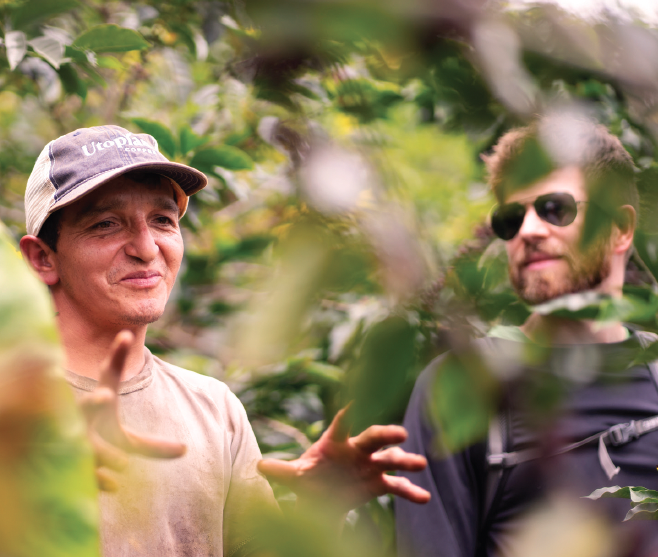
Utopian co-founder Brendon Maxwell (right) with producing partner Felix M. in Jaen, Peru, in 2021. Photo by Lino Campos.
This community-centered environmentalism isn’t just hippie-dippie idealism. It’s often driven by and develops in response to simple economic realities. The Utopian team recently visited coffee farms in Burundi, where Brendon learned from local farmers that industrial fertilizers and pesticides are simply unavailable because multinational chemical corporations don’t see a business case for operating in the country. There’s no money in it for them. Yet necessity remains the mother of invention. So Burundian coffee producers have found clever workarounds. They let chickens roam the fields, eating harmful insects and depositing natural fertilizer. They homebrew their own organic pesticides from chili peppers distilled in water and sprayed on the crops. Their farms are regenerative and organic almost by happenstance, by the simple accessibility and obvious logic of the method.
To date, Utopian has purchased and roasted over 1 million pounds of ROC coffee. But the company also understands that when big government gets involved, with its expensive certifications and demand for rigorous proofs, it’s farmers like these who feel the squeeze, who wonder if all the hassle is really worth it. So Utopian partners with cooperatives like Abakundakawa in Rwanda, investing in and supporting farmers who make the transition, and today, Abakundakawa is on track to produce the first ROC coffee on the continent.
Still, there must be a financial incentive for producers. There must be a good reason, preferably payable in silver, that they should undertake the headache of certification. There must be consumer demand. There must be a market for their product. So Utopian becomes the market. The company commits, upfront and sight unseen, to purchasing specific volumes of coffee. It guarantees the farmers’ investments in the transition with its own checkbook.
But what if the coffee isn’t good come harvest time? What if the quality isn’t where the company expects it to be?
“There’s always risk in business,” Brendon says. “We’re never going to take a risk that leverages the company, but I will make bets that I believe are worthwhile. And when you’re at the tip of the spear, you probably have to take more of those risks.” He leans back in his chair, shrugging away any abstract metaphor for a simpler truth. “Look, the only truly sustainable coffee is good coffee. I can tell you about how we’re helping widows and orphans, but if you take a sip of the coffee and want to spit it out, you’ll go down the street and buy something else.”
So, what if the coffee just isn’t that good? He laughs. “We’re still going to stand by those producers. But maybe it’ll be in a blend.”
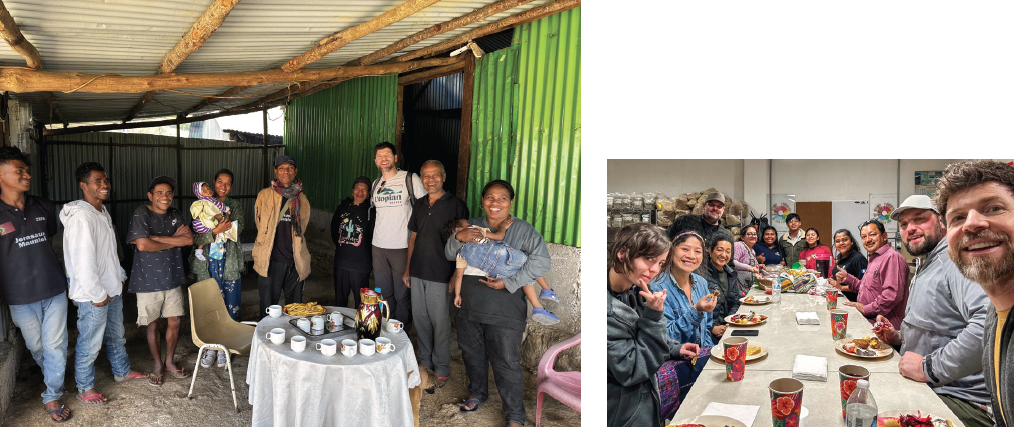
(Left) Brendon (in the Utopian t-shirt) with Antonio Tillman and family in Timor-Leste in 2026. (Right) The Utopian team with producers in Joyabaj, Guatemala in 2026.
A JOY FOR ROASTING
Fortunately, that’s not a problem Utopian seems to have, because the coffee it’s roasting is exceptionally good. Roaster of the Year sensory judges were blown away by Utopian’s Colombia Wilton Benitez Geisha, a yeast-inoculated medium-light roast that won gold at the 2025 Global Coffee Awards with notes of ripe red fruit and an herbal sensation reminiscent of mint. The judges also appreciated Utopian’s Canopy Blend, with its satiny body and complex flavors of dried fruit, honey, and spice.
It all starts with quality control, led by Director of Coffee Nick Berardi. All beans undergo comprehensive screen grading to ensure even, predictable roasts. The company uses UV light to spot defects in green beans that would be invisible to the naked eye. And then, critically, the company uses this very specific data to provide equally specific feedback to producers, giving them actionable, prescriptive ways to improve their harvests.
“We discovered embryonic damage and inconsistent color under UV from a producer we’ve been working with for five years,” says Nick. “So I was able to ask them, ‘Hey, did you maybe dry this coffee too fast?’” This helped the producer pinpoint a potential issue in their post-harvest process, and rather than creating friction between buyer and seller, it grew the trust between them and made their partnership even stronger.
And while light roasts are the darlings of the specialty coffee business, Utopian puts the same pride, precision, and pleasure into its dark roasts. “The viscosity, the weight, where we choose to straddle the line of caramelization and carbonization—there’s a grip of things that go into making a darker roast your playground,” Nick explains with the bubbly eagerness only a roaster could understand. “I like to try to give dark roasts as much importance as our single-origin light roasts.” Plus, he says, “It allows us to train our roaster operators on a different set of skills, not just on the roaster, but on the cupping table as well.”
This plays out in Utopian’s dark roast Obsidian blend, also using ROC coffees, which is described on the company’s website as “roasty but never burnt … the perfect balance between classic, bold, smoky dark roast flavors and the unique, nuanced notes of each component coffee.”
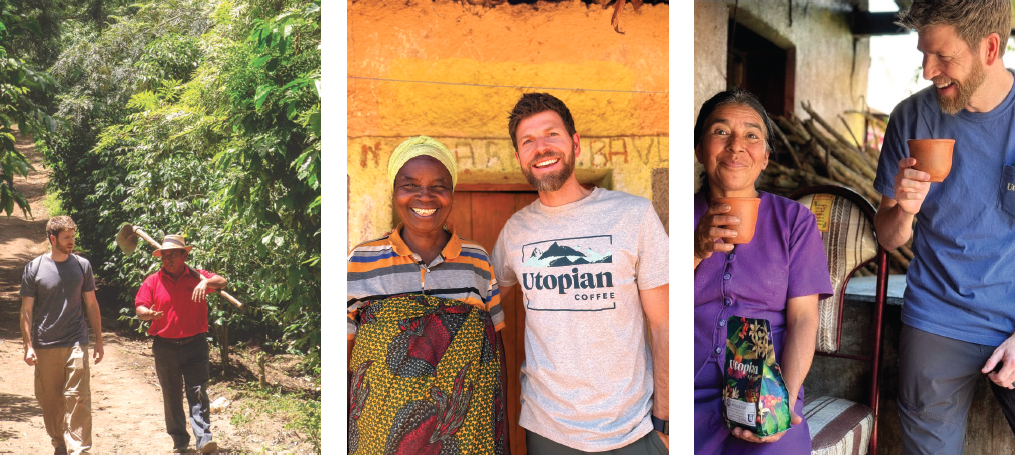
(Left) Brendon with a producer in Antigua, Guatemala, in 2014. (Middle) Brendon with Radegonde N. in Burundi in 2024. (Right) Brendon with Doña Clara in Oaxaca, Mexico, in 2024.
TELLING THE STORY
The relentless commitment to regenerative farming and sustainability, the passion for roasting, the devil-may-care middle finger to the bottom line—it’s all well and good. But how do you make people care?
Utopian views marketing as “an act of translation.” It’s not about the awards on the bag, the colorful graphics, or the eye-catching stickers. It’s about communicating why it all matters—who grew it and where, and what their life is and should be. “The people at the cultivation level contribute far more to the global ecosystem than a single cup of coffee is worth,” Chloe says. So Utopian uses its packaging to educate consumers about this worth. “We treat the packaging itself as an educational marketing tool. We include a guided tasting and an in-depth origin story, creating a rich, layered experience for the buyer. Each release highlights rare varieties, experimental processing, and farms deeply committed to regenerative practices,” she explains.
Yes, the bags show the company’s awards. Yes, they have the ROC insignia. But these are just gateways, introductions, to the real story taking place in Fort Wayne, Indiana, and on farms across the globe.
MAKING IT MAKE SENSE
So, is it nature or nurture? Is it genetics that makes a young man spend his last $750 to start an online coffee company in the age of MySpace? Is it social conditioning that makes an entrepreneur believe that caring for the land one microlot at a time could help save the whole world? Is it heredity? Is it upbringing? Is it madness?
Perhaps it’s all of the above. Perhaps it’s about nurturing our better natures, about making doing things the right way make sense. About creating opportunities for people to be their best selves everywhere you go, leaving a belief in better tomorrows behind you like seeds, just waiting to grow.
* * *
JASON ROGERS lives in Washington, D.C., with his wife and son and works as a writer and journalist. He loves hockey, rock climbing, and a travel mug of coffee on the golf course.
Advertisement