By Teddy Liao and Stacey Lynden
In recent years, decaffeinated coffee has undergone a quiet but significant transformation in the specialty landscape. Long viewed as a compromise—associated with inferior flavor, outdated processing methods, or negative assumptions about quality—decaf is now being reconsidered. Today, the category has come to be an important part of any coffee menu, for consumers and professionals alike. This shift is driven by greater awareness around health, sleep, and caffeine sensitivity, as well as changing generational attitudes that embrace a wider range of beverage options in general. According to a 2022 study conducted by Hanover Research, commissioned by Swiss Water Decaffeinated Coffee Inc., Millennial and Gen Z consumers are far more likely than previous generations to choose decaf.
Growing interest has also been supported by greater transparency and education across the industry. Influential voices, such as James Hoffmann, have helped demystify decaffeination, prompting more informed conversations among both professionals and consumers. At the same time, improvements in processing techniques, green coffee selection, and roasting technology have narrowed the sensory gap between decaffeinated and caffeinated coffees.
Today’s decafs are cleaner, sweeter, and more expressive than their predecessors, raising important questions for the roasting community: What new insights do we have into decaf, and how might current research guide more effective roasting strategies?
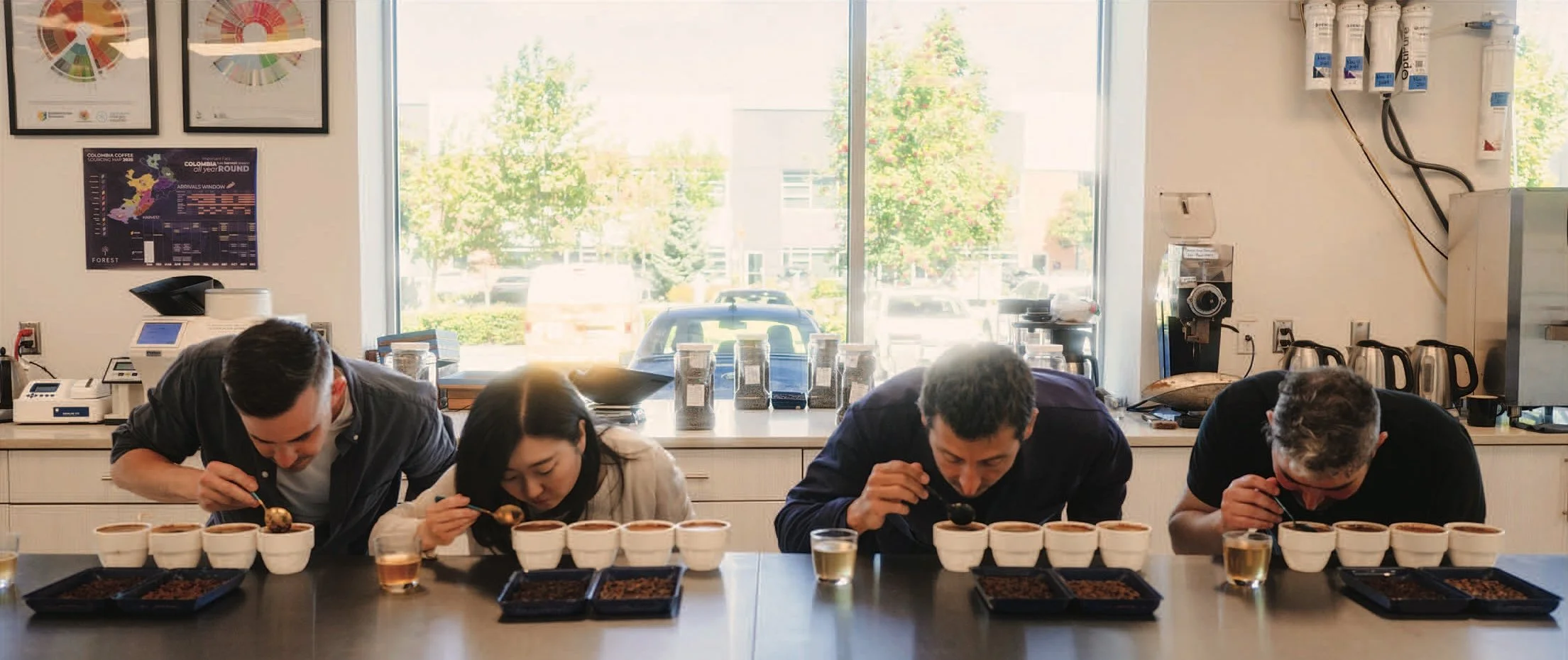
Recent research conducted at the Zurich University of Applied Sciences, in partnership with Swiss Water Decaffeinated Coffee, has led to new insights into roasting decaffeinated coffee.
HOW DECAF BEHAVES DIFFERENTLY
Decaffeination is not a neutral step in coffee processing. Whether caffeine is removed through water- or solvent-based methods, any decaf process inevitably alters the physical and chemical structure of the coffee bean. These changes affect moisture distribution, density, cellular integrity, internal pressure, and how the bean absorbs and transfers heat during roasting. As a result, decaf does not behave like a standard green coffee once it enters the roaster.
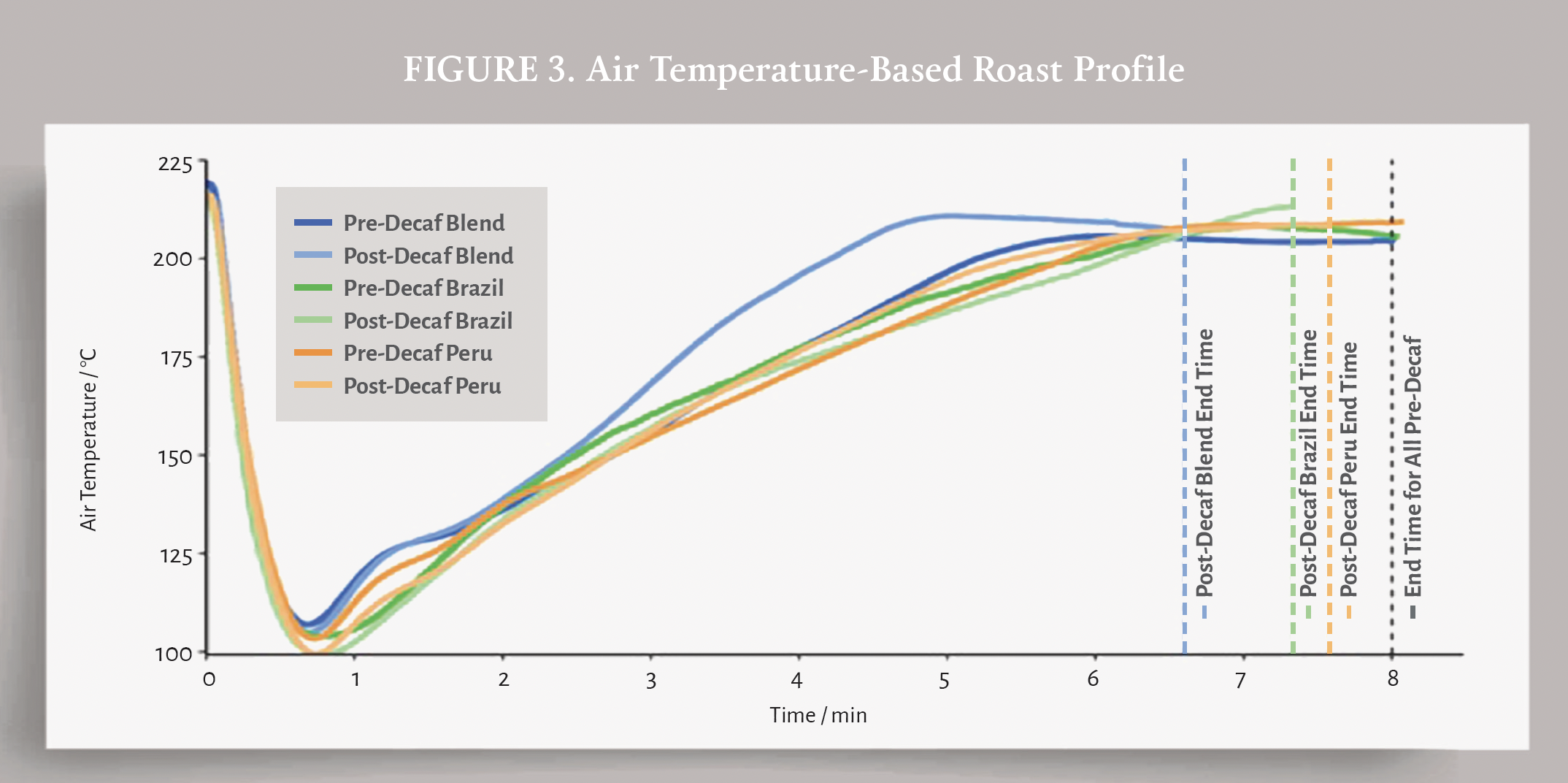
Recent research conducted by the Zurich University of Applied Sciences (ZHAW) Coffee Excellence Center, in partnership with Swiss Water Decaffeinated Coffee, helps quantify many of the differences that roasters have observed anecdotally for years. The study included three different coffees—a Colombia-Brazil blend; a Brazil 2/3 SSFC 14/16; and a Peru Organic Grade 1. Five to six 500-gram replicates of each coffee were tested both pre- and post-decaffeination. All samples were decaffeinated using the Swiss Water Process. Samples were roasted on a Roest L100 machine in 100-gram batches. Air temperature profiles remained constant across pre- and post-decaffeination coffees, and all coffees were roasted to the same light roast color (a target of Colorette 144).
Results from this study suggest that the decaffeinated coffees tested exhibit higher density and water activity, develop darker surface color, absorb heat more efficiently, and build less internal pressure during roasting. First crack when roasting decaf is typically quieter and less pronounced, and the chemical pathways responsible for flavor formation shift as well—producing fewer pyrazines, which may lead to a reduction in nutty, roasted, and chocolate notes, and relatively more aldehydes, which may result in a stronger malty flavor. Together, these variations require roasters to recalibrate both their expectations and their technical approach. The Swiss Water team has developed guidance based on these findings, available at swisswater.com/roasting-guide.
PHYSICAL SHIFTS IN THE DECAF GREEN BEAN
While different methods can be used for decaffeination, they all follow the same basic process, which involves hydrating the beans to prepare for extraction, removing the caffeine via a chemical or chemical-free solvent, then drying the beans. Many variations exist in terms of how many solids are removed and what solvents are used.
Even comparatively gentle, chemical-free methods bring about structural changes within the green coffee bean. Impacts of decaffeination include liquid moving through the cellular matrix during hydration, caffeine removal, and the bean being subsequently dried back to stable storage conditions. While these changes may be subtle when viewed externally, they have profound effects at the microscopic level. Cell walls, pores, and internal voids are altered in ways that influence how energy, moisture, and pressure behave during roasting. Let’s take a closer look at how these changes influence the key variables that matter most in roasting.
Density Increases: A Key Driver of Roast Behavior
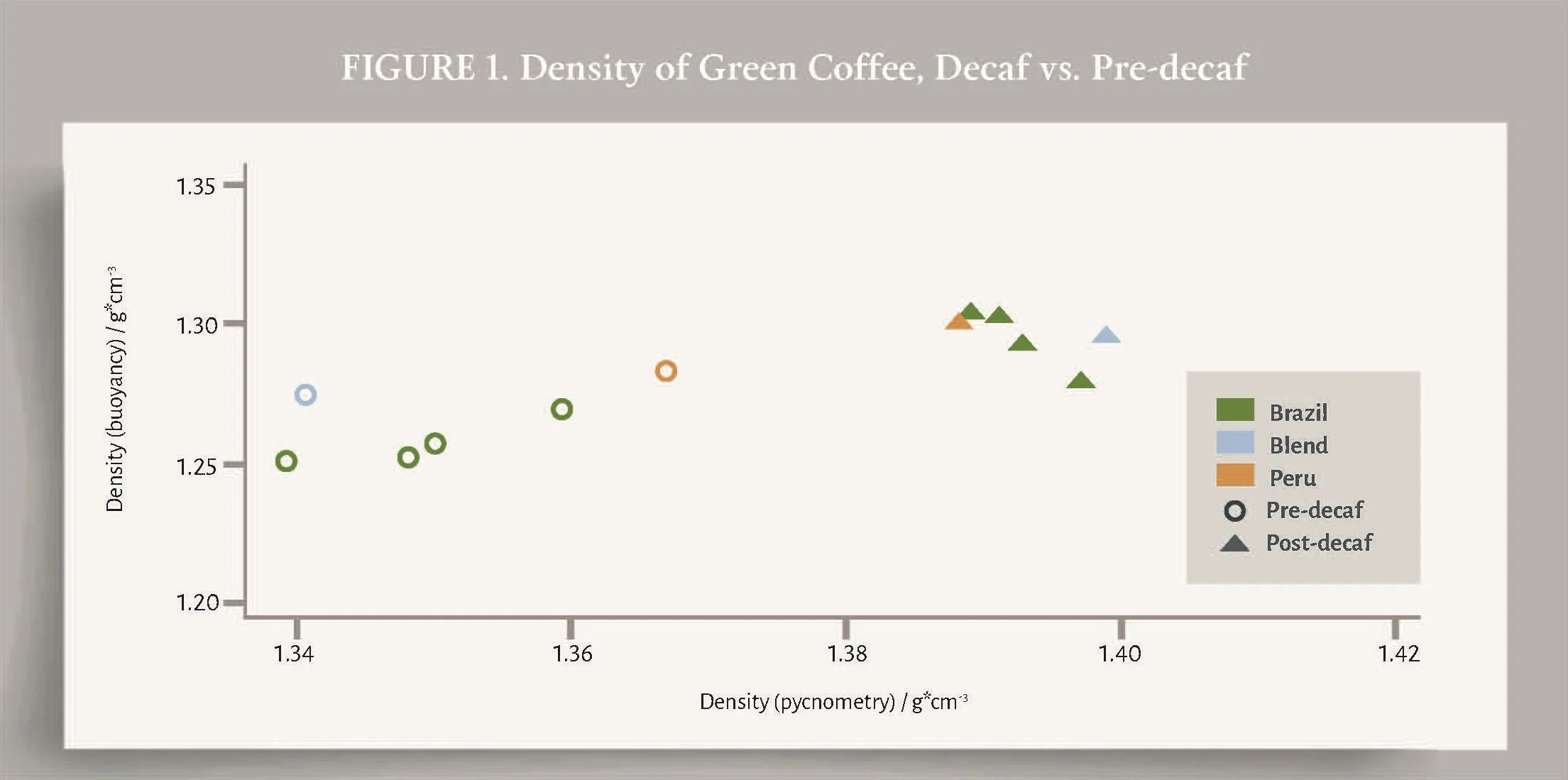
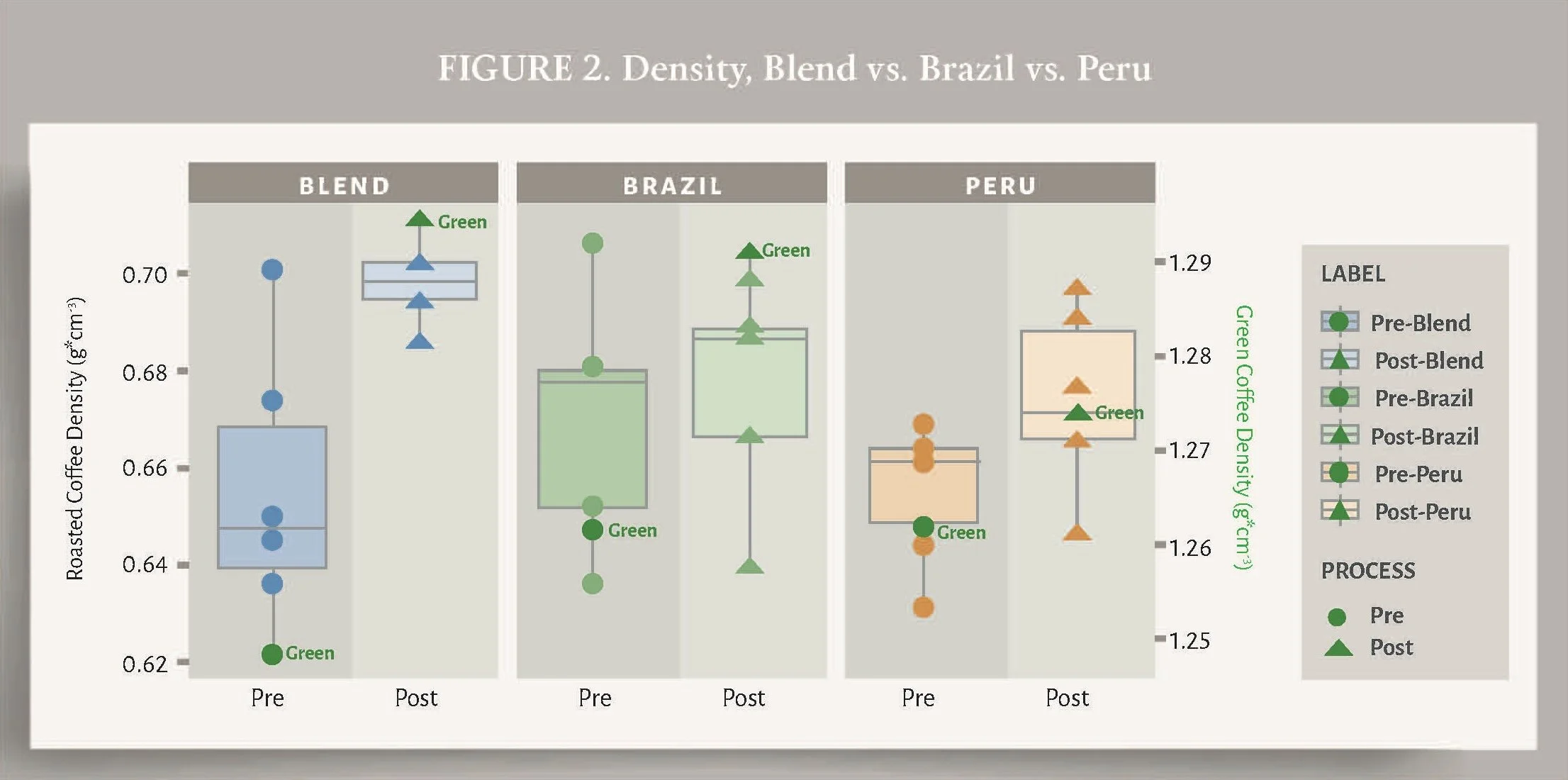
One of the most consistent findings from the ZHAW research is that decaffeinated green coffee exhibits higher density than its pre-decaffeinated counterpart.(See Figure 1 and Figure 2.) Using both buoyancy testing and pycnometry—which measures the skeletal density of the beans—researchers confirmed density increases across multiple origins. This shift in density plays a central role in how decaf responds to heat in the roaster. Although denser beans initially take on energy more slowly, once heat is established it is absorbed and transferred throughout the bean more efficiently. In practice, this often favors a higher charge temperature paired with more restrained heat application, allowing momentum to build in a controlled and predictable way. Designing the roast with this higher density in mind leads to more coherent profiles overall and helps explain why decaf roast curves tend to run faster—meaning both a faster rate of rise and a shorter overall roast time—particularly when roasters attempt to match caffeinated profiles visually or conceptually rather than structurally. (See Figure 3.)
Water Activity Rises Despite Moisture Changes
Another critical distinction lies in water activity. Although moisture content in green coffee is often similar before and after decaffeination, decaf green coffee frequently exhibits higher water activity. This indicates that water molecules in the bean are more mobile and more chemically reactive following decaffeination.
Structural changes caused by decaffeination—including changes to cell structure, bound moisture distribution, and soluble solids—can also affect capacitance-based moisture measurements. As a result, many capacitance moisture meters require a decaf-specific calibration curve to accurately correlate electrical readings with true oven-determined moisture content.
Elevated water activity influences roasting chemistry in several important ways and may contribute to the faster roast progression observed in decaffeinated coffees. For many roasters, this helps explain the familiar sensation that decaf “gets away” from them when standard profiles are applied without adjustment.
Structural Changes Affect Pressure and Flavor Formation
Following decaffeination, the coffee bean’s internal structure is impacted in ways that yield a higher density and limit how pressure builds and is released during roasting. Decaffeinated beans have collapsed cell chambers which lessens the pressure buildup during roasting. With less pressure developing inside the bean, first crack becomes more subtle and bean expansion is limited. These changes may also influence flavor formation by affecting reactions such as Strecker degradation, which contributes to the formation of pyrazines and volatile aldehydes associated with roasted, nutty, and fruity aromas. Roasters must carefully manage roast progression to maintain balance between sweetness, acidity, body, and aromatic complexity, especially given decaf’s tendency to move quickly through key developmental phases.
Understanding how the decaffeination process alters properties central to heat transfer and roast development is key to adjusting roast profiles effectively for decaf coffees.
BUILDING PRACTICAL ROASTING STRATEGIES
Differences between decaffeinated and caffeinated coffees have long been acknowledged in practice, yet they are often insufficiently defined in technical terms. As a result, roasters often rely on experiential knowledge rather than predictive models when working with decaf. The ZHAW study provides empirical validation for this longstanding disconnect and situates it within a coherent scientific framework.
By demonstrating that decaffeinated coffees exhibit measurable structural and thermophysical differences relative to coffees that have not gone through the decaffeination process, the research challenges the assumption that decaf can be treated as a minor variation of green coffee. Instead, it suggests that decaffeination alters properties central to heat transfer and roast development. Recognizing these distinctions enables a shift away from reactive adjustment and toward intentional roasting.
Building on this understanding, let’s explore how these altered properties manifest while roasting and how roasters can adapt profiling strategies accordingly.
Reset Color Development Expectations
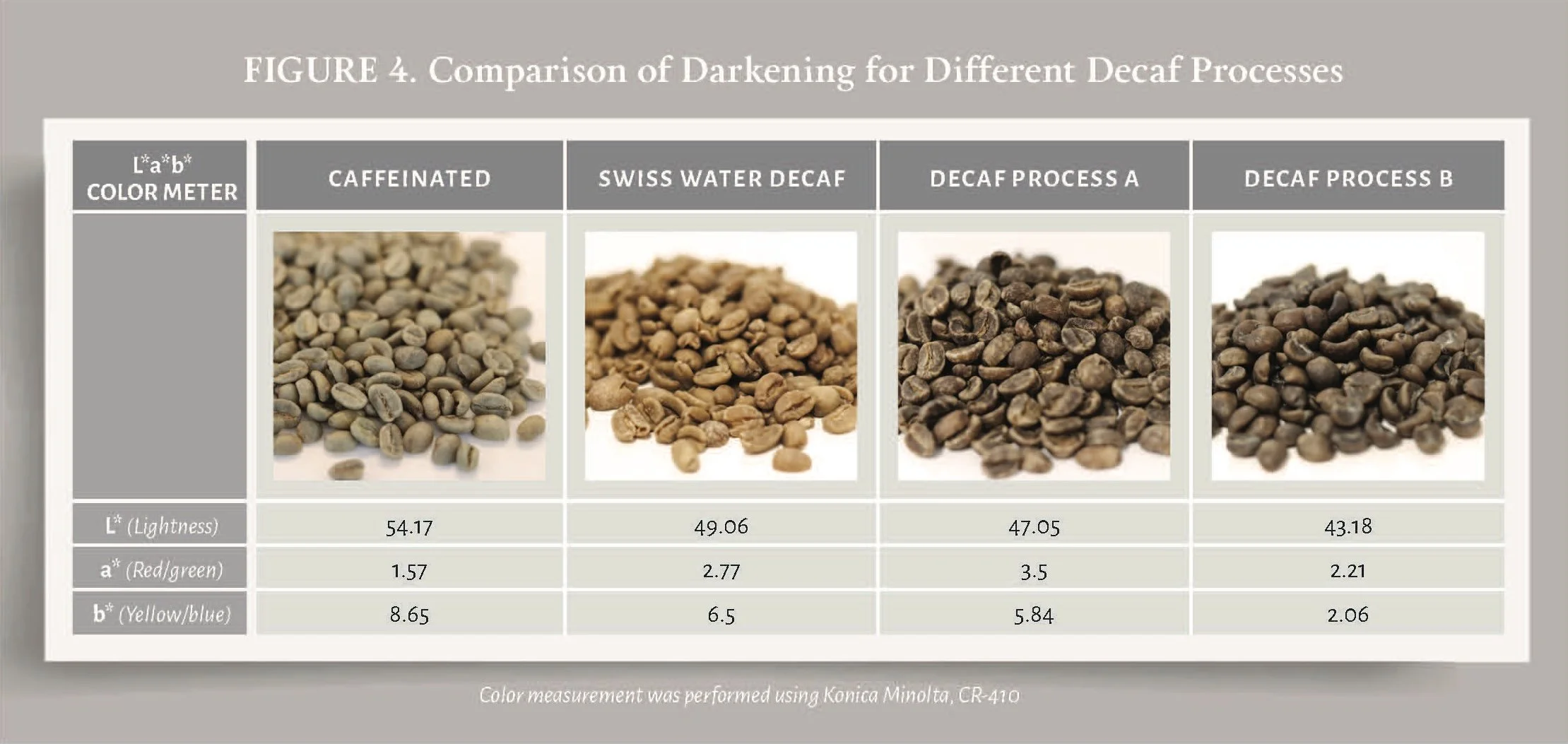
While the overall progression of decaf roasting mirrors that of caffeinated coffee, external color development is consistently advanced at every stage—beginning even before the roast starts. According to research conducted by Swiss Water Decaffeinated Coffee, which compared unroasted whole and ground caffeinated and decaffeinated beans using an L*a*b* color meter, the surface of green coffee visibly darkens during decaffeination, often widening the gap between outer bean color and internal bean color, with the degree of darkening varying by decaffeination method. (See Figure 4.) This preexisting color difference persists throughout roasting. As a result, ground coffee color becomes a more reliable indicator of true roast development than surface appearance alone. Relying solely on the color of the whole bean can easily lead to underdeveloped flavor and inconsistent results. Building proper momentum toward first crack and an even expansion of the bean at first crack is a better indicator that the roast is moving in the right direction.
Rethink Roasting Stages
As a roast progresses through the drying, Maillard, and development phases, decaffeinated coffee behaves differently from caffeinated coffee, likely due to faster heat transfer and altered pressure dynamics. Shorter drying times and earlier Maillard onset require careful energy control to avoid rushing critical reactions. Managing heat input to encourage sufficient pressure buildup can promote more even expansion and a clearer first crack signal, while a gentle, controlled development phase helps prevent stalling or runaway momentum.
A useful approach when roasting decaf is to work backward from the target cup. Whether aiming for a brighter, more aromatic profile or a rounder, more developed one, roasters can shape heat, airflow, and phase lengths to support their desired outcome.
When the goal is a brighter cup, the aim is to protect acidity and aromatics while still building enough structure in the Maillard stage for sweetness. In practice, that often means avoiding an overly long or low-energy drying phase (which can mute brighter aromatics), then carrying steady, moderate heat through Maillard so the coffee arrives at first crack with controlled momentum rather than excess stored heat. A slightly shorter drying phase paired with airflow and heat adjustments to prevent tipping or scorching can preserve organic acids and lift perceived brightness.
Conversely, extending post-crack development while managing momentum by steadily tapering heat and keeping rate of rise on a controlled decline tends to round the profile and increase body without veering into roast-driven flavors. Rather than forcing decaf into a familiar framework, roasters benefit from rebalancing stages based on decaf’s inherent behavior.
Ultimately, successful decaf roasting requires more than minor technical adjustments—it demands a unique approach specifically designed for the category.
Forget Listening for First Crack—Use Visual and Aroma Cues
Decaf’s muted first crack makes sound a less reliable reference point. Early popcorning sounds often occur before true structural first crack and should not be mistaken for its onset; jumping the gun at this stage can leave the roast underenergized, increasing the risk of a stall or crash later in development. Roasters should rely more heavily on rate of rise trends, exhaust behavior, and bean temperature, alongside aroma and visual cues.
Visual indicators such as surface texture; color transition toward a more uniform brown; and full, even bean expansion can often provide a clearer confirmation of internal progression than sound alone. Aromatically, the emergence of a vinegar-like acidity is often the first reliable indication of true first crack, preceding sweeter, caramelized, or lightly toasted aromas as the roast moves into development. Controlled airflow and fan settings are essential in maintaining predictable thermal behavior and repeatability. This shift encourages a more analytical, data-driven approach that aligns well with decaf’s narrower margin for error.
Pay Closer Attention to the Development Phase
The development phase is where decaf profiles are most easily compromised. Decaffeination alters bean structure and changes the thermal accessibility of sugars and organic acids during roasting. Development during roasting can accelerate or tip more quickly toward roast-driven character if momentum is not carefully managed. A more gentle and controlled approach, prioritizing small, incremental energy changes, can help preserve sweetness and clarity while avoiding stalling or runaway progression. Development time should be treated less as a fixed percentage and more as an adaptive phase, adjusted in real time based on aroma, rate of rise, and bean appearance. With careful control, the development phase is where decaf’s flavor potential is defined rather than diminished.
Roasting to Highlight Different Attributes
Keeping the previously mentioned factors in mind and putting the ZHAW post-decaf roasting research to use, we prioritized practical questions: whether faster roasting is driven primarily by higher heat transfer or by faster color formation, how to manage the typically lower first-crack intensity, whether potentially lower internal pressure during roasting changes flavor-formation kinetics, and what specific roasting guidance best develops different attributes of acidity versus body. This priority was driven by the outcome of James Hoffmann’s 2024 Decaf Project, which suggested that the largest impact on the flavor of decaffeinated coffee was roasting.
A SHIFT IN MINDSET
Ultimately, successful decaf roasting requires more than technical adjustments—it demands a change in perspective. Rather than working against decaf’s altered structure, roasters can learn to harness it to produce expressive, well-balanced coffees. This shift reframes decaf as its own roasting category, where profiles are designed from sensory intent and faster progression is treated as a creative constraint, not a drawback. By prioritizing repeatability through consistent color tracking and data analysis, decaf moves from being a low-priority obligation to a meaningful technical challenge within the roaster’s craft.
This all might sound like a homework assignment, especially if you roast more than one decaffeinated coffee. Some roasters report that coffees processed using the Swiss Water Process tend to roast consistently across different coffees. Because moisture content and water activity are maintained within a controlled range during this process, roast profiles developed for one coffee may transfer to another with only modest adjustments, although the specific characteristics of each coffee should still be considered.
LOOKING AHEAD
As specialty coffee continues to evolve and consumer expectations rise, decaf represents a significant opportunity for differentiation and innovation. Through high-quality coffees being decaffeinated, rigorous heat management, tailored airflow, thoughtful phase balancing, and roaster-specific refinements, decaf can confidently stand alongside any caffeinated offering.
For an industry built on curiosity and craftsmanship, embracing decaf with this level of intentionality is more than a technical exercise. It is an opportunity to redefine quality standards and expand the boundaries of specialty coffee itself. Decaf is no longer defined by what is missing, but by what remains, and by what can be unlocked through skill, respect, and a deeper understanding of the bean.
For more information on roasting decaf, find Swiss Water Decaffeinated Coffee’s new guidelines, which were informed by the research project commissioned through ZHAW, at swisswater.com/roasting-guide.
TEDDY LIAO has worked in coffee for more than 10 years, building experience as a barista, trainer, roaster, and retail operations manager through various unexpected and appreciated opportunities. Now, they work in coffee quality assurance as a cupping room technician for Swiss Water, assisting the green buying team on evaluating coffees going in and out of the facility. In their spare time, Liao continues to work in local cafes because the slice-of-life scenes of people bonding over coffee is worth watching over and over again.
STACEY LYNDEN is the cupping lab manager at Swiss Water, where she and her team oversee sensory evaluation and quality for all of the coffees Swiss Water purchases and all of the decaf produced. With over 20 years working in coffee, her experience spans roasting, sensory evaluation, coffee education, and green coffee sourcing. Lynden is the 2024 and 2025 Canadian Coffee in Good Spirits Champion and is passionate about advancing quality and creating more inclusive specialty coffee experiences.
Advertisement