Brewing a Winning Team: People Strategy for Roasteries and Cafes
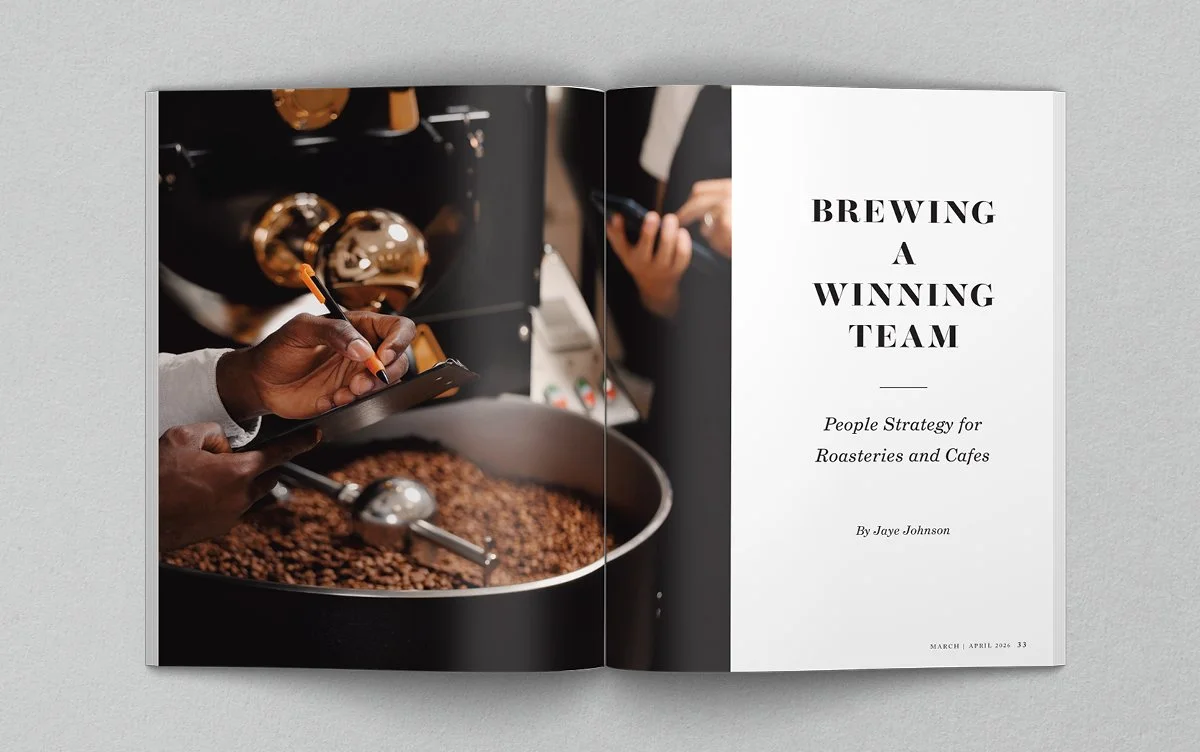
By Jaye Johnson
The coffee industry is no stranger to volatility. Frost in Brazil, shipping delays, currency swings, and consumer trends that spike and fade in a matter of months are all part of doing business. But the most disruptive variable for roasters and cafe owners may not appear on the “C” market chart. Instead, it often shows up in staffing and scheduling, who is on bar, who is in the roastery, and who is burning out or leaving altogether.
Hiring and rehiring for the same roles, training baristas who end up resigning shortly thereafter, production teams stretched thin, and managers trying to meet guest expectations with an exhausted crew can wreak havoc on a coffee business. At the same time, the broader conversation about working conditions in coffee has moved into the spotlight. Starbucks, in particular, has become a focal point, with ongoing contract negotiations and visible barista strikes across the United States.
Whatever one’s view of Starbucks, those headlines reflect questions that extend far beyond a single brand: What constitutes fair pay, what schedules are sustainable, what staffing levels are safe, and how does health care fit into a low-margin business model? If the largest coffee company in the world is under this level of scrutiny, independent roasters and cafes cannot afford to treat their people strategy as an afterthought.
That’s not to say that an independent coffee shop or small roastery should try to emulate a large corporation’s policies, but every coffee business needs to determine what it can offer employees, communicate it clearly, and set up operations to reliably maintain those offerings.
This article looks at people strategy as business strategy. It offers a practical way to connect your mission, your pay and benefits, and your everyday practices so that staffing stability becomes a deliberate outcome rather than a matter of luck.

PEOPLE STRATEGY IS BUSINESS STRATEGY
Not only is labor a significant operating expense for roasters and cafe owners, in many ways it’s the engine that drives quality. The mix of pay, benefits, culture, and growth you offer will determine whether you have an experienced, engaged team or a constant cycle of new hires.
That mix shows up everywhere: in beverage quality and consistency, in how quickly and warmly guests are greeted, in whether your operation can take on additional wholesale accounts or locations, and in how much of an owner’s time is spent developing the business rather than filling shifts and training new staff.
Viewed this way, people strategy is not a separate human resources (HR) initiative. It is a key part of how any business performs. According to Renee Espinoza, senior consultant with Firedancer Coffee Consultants, most staffing problems “come from a mismatch between what the job requires and what the operation consistently supports, such as pay clarity, scheduling reality, and a culture that holds up under stress.”

PAIN POINTS FROM THE ROASTERY AND THE BAR
The biggest challenges related to staffing and HR typically fall into five main categories:
Hiring and turnover: Coffee is often seen as a short-term job rather than a craft worth investing in. Front-of-house and production roles often turn over quickly, which is costly and disruptive.
Schedules and hours: Today’s employees want predictable hours that work alongside school, second jobs, or family responsibilities. Operators need enough flexibility to staff peak times, cover vacations, and manage seasonality.
Benefits and perks: It can be difficult to determine what benefits your company can offer that will be meaningful for employees but also financially feasible for the business, especially with a mix of full-time and part-time staff.
Career paths: To position coffee as a career rather than a short-term job, business owners need to show employees and potential employees a clear path to growth and progression. While this sounds simple, it can take work to develop clear job descriptions, skill requirements, and opportunities for training and advancement.
Compliance concerns: Wage rules, health care requirements, and emerging pay transparency laws are evolving. It can be difficult for business leaders to stay on top of these obligations in the margins of already full days.
These issues are rarely solved by a single policy change or a one-time pay increase. They require a more coherent approach to what the business offers its people and how the operation runs day to day.
THE BUSINESS CASE FOR A DELIBERATE PEOPLE STRATEGY
The cost of turnover in a coffee business is often underestimated. Every departure demands significant time and energy for recruiting, interviewing, onboarding, and training. New baristas and production staff typically require weeks of training before they are proficient on the bar or at the roaster. Errors in dialing in espresso, managing inventory, or fulfilling orders are part of that ramp-up, and those mistakes have both financial and reputational costs.
The benefits of retaining a team are equally tangible. Experienced teams catch small quality issues before they reach guests; move more efficiently during rushes because they understand each other’s rhythms; and hold institutional knowledge about regular customers, seasonal patterns, and equipment quirks. This creates the capacity to expand into wholesale, events, or additional locations without sacrificing standards.
“When a shop is constantly onboarding, they are not just replacing labor,” says Espinoza. “They are losing institutional knowledge like what regulars like, how equipment behaves, and the small standards that protect the brand.”
Again, the objective for a small to midsize business is not to replicate a large corporate benefits package. The objective is to build a rewards mix aligned with your company’s size, budget, and values that feels coherent and fair to the people doing the work.
To make this more manageable, the following sections outline what I call the BREW + POUR framework, developed specifically with roasters and cafe owners in mind. I created the framework after working in HR for a large hospitality and restaurant company, translating the core principles of total rewards—an approach that considers compensation, benefits, and the full employee experience—into a simple, step-by-step program for small to midsize coffee companies and startups seeking to establish their own employee relations programs.
THE BREW + POUR REWARDS FRAMEWORK
At its core, BREW + POUR is a way to connect a coffee business’s mission and values to what employees experience at work. It separates “what we offer” from “how we offer it” and provides structure around both.
The Frame: Mission, Values, Culture
Before adjusting pay or benefits, it is useful to revisit three foundational elements:
Mission: Your mission explains why your business exists beyond simply selling coffee. This might involve community, sustainability, education, or another core purpose.
Values: Your values are the principles that guide decisions, such as radical hospitality, craft over shortcuts, or a commitment to growing people as well as revenue.
Culture: Your company culture includes your team’s shared values and standards of behavior. What does a great shift feel like? How do staff members talk to each other and to customers? How are problems solved and conflicts addressed?
Clarity in these areas makes it easier to hire, promote, and recognize people in ways that are consistent with what the company says it stands for. BREW covers the content of what you offer. POUR addresses the routines that keep it functioning.

BREW (Layer 1): What You Offer
B. BASE AND VARIABLE PAY
Base and variable pay are often the first elements people consider when evaluating a job. They work best when anchored in a clear pay philosophy.
For roasters and cafe owners, this might mean deciding whether you intend to lead, match, or sit slightly behind local market pay, and why that choice makes sense for your model. From there, straightforward pay ranges for key roles such as barista, lead barista, production roaster, lead roaster, and store manager bring structure to hiring and pay decisions.
Variable pay needs similar clarity. If you offer team bonuses, service fees, or tip pools, the mechanics should be transparent and compliant with local regulations. Tying incentives to shop-level quality, consistency, and financial performance tends to reinforce the behaviors the business needs most.
Progression rules matter as well. Simple guidelines about when pay increases occur and what skills or responsibilities are associated with those increases help employees see a path forward. Skill-based pay adjustments for milestones such as cupping proficiency, mastering brew methods, or delivering confident guest education reinforce the craft side of the work.
“Pay doesn’t need to be complicated,” says Espinoza, “but it does have to be explainable. If an employer cannot tell you what drives a raise or how tips and other service fees are handled, then trust erodes quickly.”
R. RECOGNITION AND RELATIONSHIPS
Recognition is about making sure effort and impact are visible. In a busy cafe or roastery, good work can disappear into the rush.
Small, consistent practices often have the greatest effect. A brief pre-shift huddle with two specific shout-outs from the previous day, a quick positive message from a manager after a challenging service, or a simple “thank you” tied to a concrete action all reinforce that someone’s contribution matters.
On a larger scale, quarterly values-based awards, peer nominations, and guest-driven kudos sourced from reviews or comment cards can highlight the behaviors that define the brand. Tangible rewards do not need to be extravagant. Preferred shifts, sponsored education time, participation in an industry event, or a bag of coffee and a handwritten note often carry more meaning than their cost would suggest.
E. EMPLOYEE BENEFITS AND PERKS
Benefits can feel like the territory of large companies, but smaller operators also have options. The key is tailoring the mix to the size and financial reality of the business.
Health care coverage might involve a small group plan, a health reimbursement arrangement, or a stipend that helps employees offset costs. Time off can be structured through clear sick and vacation leave policies, along with flexible holiday swaps that reflect the diversity of a team. Financial and lifestyle support may include help with public transit, a shoe stipend, a shift-meal program, discounted coffee and merchandise, or programs that allow employees to tap into a portion of their earned wages before payday.
Taken together, these benefits signal that the company recognizes employees as people with responsibilities, goals, and financial realities outside of work.
W. WELL-BEING AND WORK LIFE
Well-being is where many abstract values become concrete.
Scheduling is central. Posting schedules at least two weeks in advance, offering a reasonable baseline of hours, and minimizing close-open patterns (where the same person opens the shop the day after they closed) can improve fatigue levels and trust. Small adjustments in scheduling practices often communicate respect for people’s time more loudly than any slogan.

Physical well-being on shift is also a practical concern. Baristas and production staff spend most of their day on their feet repeating similar motions. Encouraging microbreaks during slow periods for stretching, providing anti-fatigue mats, assessing and addressing the ergonomics of equipment and work flows, and discussing appropriate footwear are all straightforward interventions.
Mental health support does not necessarily require a formal clinical program. Training supervisors in simple de-escalation and debrief strategies after difficult guest interactions and sharing information about low-cost behavioral support options all contribute to a more sustainable workday.
POUR (Layer 2): How You Offer It
P. PATHWAYS AND PROGRESSION
Clear pathways make it possible for employees to imagine a future in coffee beyond their current role.
In practice, that might mean defining a few common progressions: barista to senior barista or trainer to shift lead and eventually to management; production assistant to roaster’s assistant to production roaster to lead roaster or a quality role; or assistant buyer to junior buyer to director of coffee.
For each step, outlining the skills, behaviors, and business needs that justify a move gives both managers and employees common clarity. Basic 30-, 60-, and 90-day plans for new hires can then tie day-to-day training to longer-term progression, with optional skill badges or levels marking development in areas such as sensory, brewing, or training.
O. OPERATING POLICIES
Operating policies translate intentions into daily reality.
Written guidelines on how pay ranges work, how increases are decided, how tips or service charges are shared, and how schedules are created and adjusted provide much-needed transparency. Clear procedures for requesting time off, handling shift swaps, and communicating conflicts do the same.
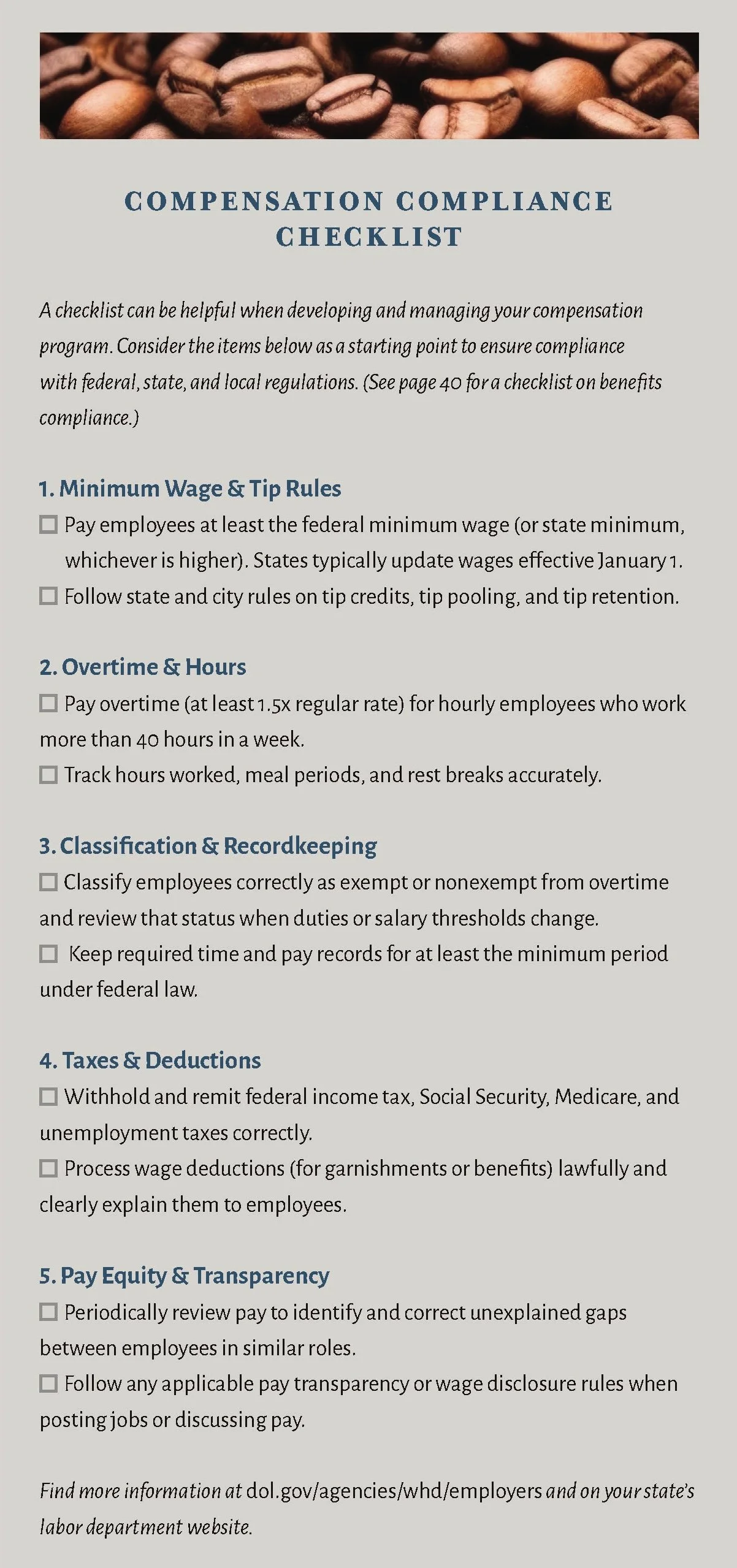
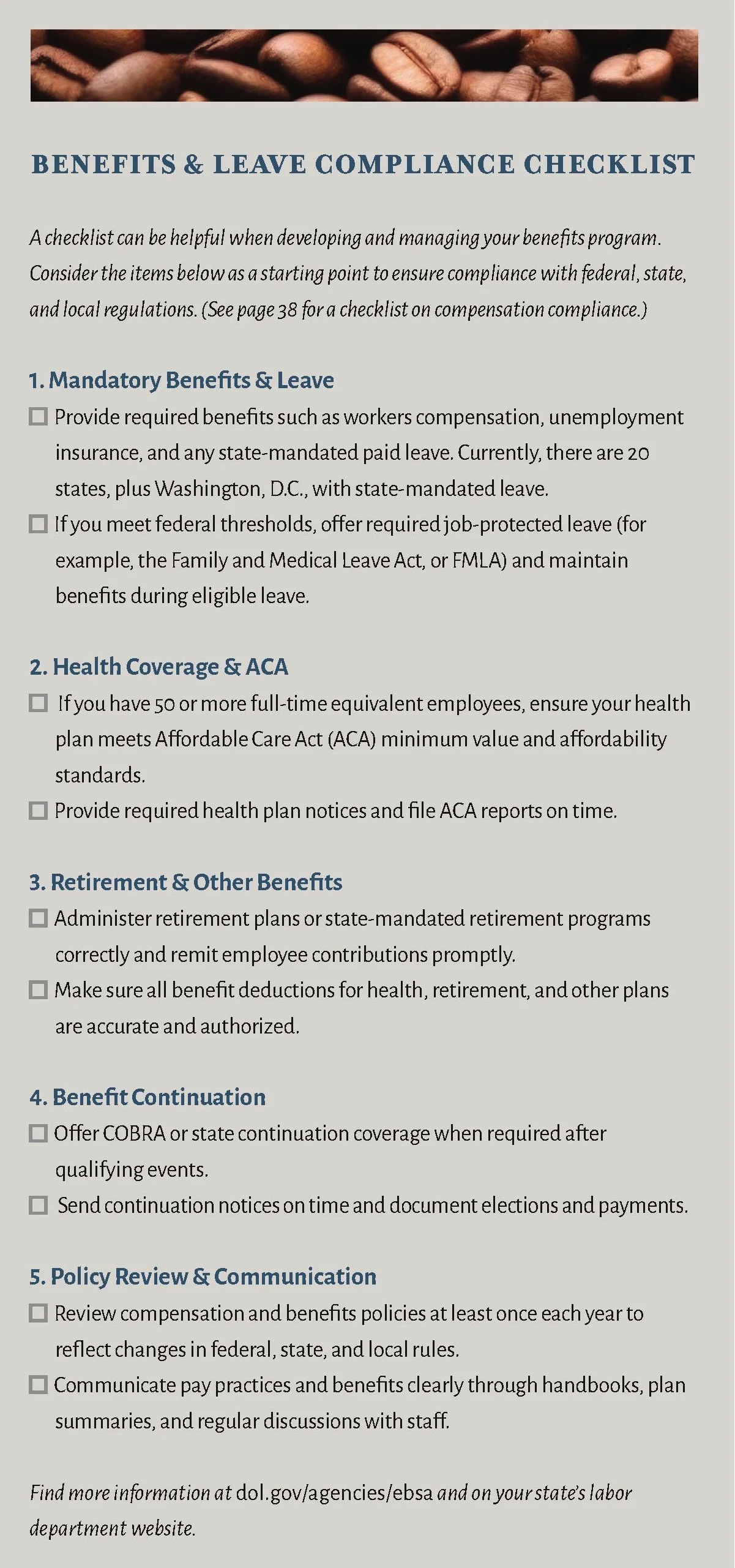
A concise compliance checklist is also valuable. For most roasters and cafe owners, this will touch on minimum wage, overtime, required breaks, and any applicable pay-transparency obligations. While a full legal analysis is beyond this article’s scope, even a basic checklist helps leaders recognize when they should seek outside advice. (See sample compliance checklists below.)
The connection to reputation is not theoretical. In larger companies, breakdowns between stated policies and lived experiences are often at the heart of labor disputes and public criticism. Smaller businesses are not immune to similar dynamics.
U. UNDERSTANDING AND FEEDBACK
Feedback flows from leaders to employees, from employees to leaders, and from guests back into the operation.
Structured listening points can include a 90-day check-in with new hires, short periodic surveys to gauge engagement and gather suggestions, and “stay” interviews with key team members focused on what keeps them there and what might cause them to leave.
“Good leadership listens to their staff’s ideas and insights, responding and engaging to create collaborative, poised solutions,” says Darrin Daniel, former executive director of Cup of Excellence/Alliance for Coffee Excellence and founder of Cityful Press Coffee Consulting. “It is essential to lift the team up in order to balance the success and goals of an organization.”
On the guest side, QR codes and comment cards can provide quick access for feedback on drinks, service, and the overall environment. Sharing positive guest comments with staff helps connect daily work to the guest experience. Using critiques as coaching opportunities rather than blame reinforces a learning culture.
R. RESULTS AND READOUTS
Without measurement, it is difficult to know whether any of these efforts are working. A simple monthly snapshot might track turnover by role, time to fill open positions, time to productivity for new baristas and production staff, and participation in benefits or recognition programs. On a quarterly basis, it is useful to look at internal pay equity patterns and to review whether scheduling or staffing practices need adjustment.
The point is not to achieve perfection on a complex dashboard. It is to see enough to make informed decisions.

LEGAL AND COMPLIANCE TOUCHPOINTS
Legal requirements are an important backdrop for any people strategy. “If you’re improvising on pay, breaks, or scheduling, you’re taking on risks that you probably didn’t mean to,” says Espinoza. “A short checklist and an occasional check-in with a professional are much less expensive than fixing a problem after it’s gone public.” (See samples checklists below.)
While this article cannot provide legal advice, it is worth noting a few areas where roasters and cafe owners commonly have questions:
Minimum wage and overtime rules for the states or cities in which they operate.
Pay transparency obligations for job postings.
Health care coverage requirements under federal law as headcount increases.
Because these rules change and often depend on location and size, many operators rely on a combination of official resources—such as state and federal labor department websites and curated tools that track pay transparency laws by state—then confirm details with legal or HR advisors.
“You don’t need to be an employment-law expert to run a great coffee business,” Espinoza adds, “but you do need the discipline to review your policies frequently and notice when your business has outgrown what you currently have in place or when it’s time to get some outside guidance.”

A PRACTICAL PATH FOR SMALLER OPERATORS
For a one- or two-shop cafe or a small roastery, the full scope of people strategy can feel daunting. The work does not need to happen all at once.
A phased approach over roughly 90 days might look like this:
Clarify your company’s mission, values, and the culture you are aiming for, then communicate those to the team. (Depending on the size of your business and your vision for the company culture, you could even include your staff in defining or redefining the mission, vision, and culture statements.)
Set or refine pay ranges for current roles and explain in simple terms how pay decisions are made.
Make immediate improvements to scheduling, such as posting schedules earlier, minimizing close-open patterns, and aiming for more predictable base hours.
Introduce microbreaks as standard practice and build in a brief recognition moment at shift huddles.
Map basic career progressions for baristas, production staff, and leadership roles, and create 30-, 60-, and 90-day plans for new hires.
Pilot one listening mechanism, such as a short pulse survey or a round of stay interviews, and visibly act on at least one theme that emerges.
Once these elements are in place, additional layers, such as a more formal benefits program, a deeper training program, or a more robust scorecard can be added incrementally.
BREWING NOT JUST COFFEE BUT CAREERS
Coffee businesses cannot control global supply constraints, weather shocks in producing countries, or the labor disputes playing out in corporate boardrooms, but they can decide how they design roles, pay people, structure schedules, and respond when staff speak up.
In a volatile market, those choices are not only ethical considerations; they are competitive levers. Teams who feel valued and can see a path forward are more likely to stay, build their skills, and deliver the kind of consistent quality and hospitality that differentiates a brand.
Roasters and cafe owners already bring care and precision to sourcing, roasting, and brewing. Applying that same level of intention to people strategy can turn a workplace from a revolving door into a place where careers in coffee are built. In many ways, that matters as much as the coffee in the cup.
* * *
Jaye Johnson is a human resources and rewards consultant and owner of The Avoir Company, based in Atlanta. She works with roasters, cafes, small businesses, and hospitality and retail teams to design fair, sustainable pay and people practices.
Advertisement